
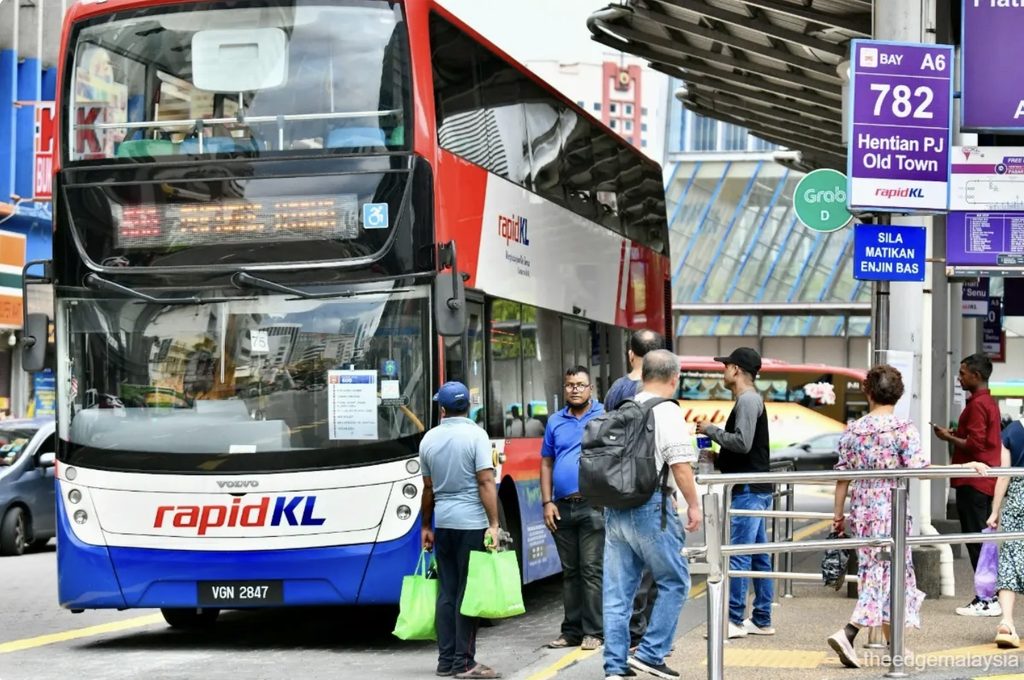
Originally published by The Edge Malaysia on 27 Aug 2026. Photo credit: by Sam Fong/The Edge
Malaysia has poured billions of ringgit into rail — the LRT, MRT and, most recently, LRT3 — yet millions of commuters remain stuck in daily gridlock. A transit system is only as strong as its feeder network, and here, that network is buses.
Today, public buses here mean long, unpredictable waits, “ghost buses” that vanish from tracking apps, and vast gaps in suburban coverage. Commuters aren’t choosing their own vehicles out of habit — they’re pushed into them because the bus system offers no reliable, dignified alternative.
A thin bus fleet, a thin ridership base
Klang Valley runs around 1,200 buses across roughly 300 to 323 routes, depending on the source. A simple bus-to-population ratio — buses per 1,000 residents — sizes up the problem: not an efficiency benchmark, but a blunt gauge of bus supply relative to population served.
On that formula, the Klang Valley’s ratio works out to 0.14 — one bus for every 7,000 residents. Comparable cities post markedly higher ratios, and higher ridership to match:
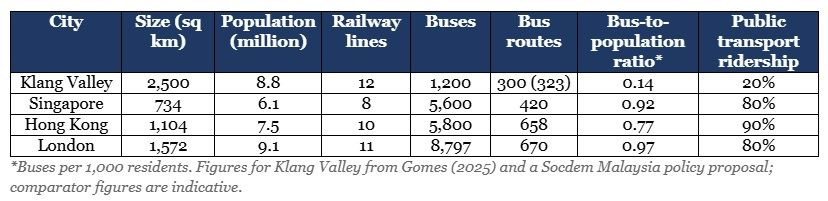
To reach Hong Kong’s ratio of 0.77, Klang Valley needs another 5,600 buses. The government’s RM1.9 billion allocation in 2025 for 1,660 buses to replace ageing fleets is a welcome step, but still leaves a shortfall of roughly 4,000 buses.
The Klang Valley has more railway lines than any of these cities, but a functional system needs buses running at high frequency. Commuters routinely cite unreliable schedules and poor real-time information as reasons to avoid buses — a smooth MRT or LRT ride means little if the last mile is missing.
Buses still matter
Buses in the Klang Valley should not be a fallback — in Singapore, buses are the primary mode for most public transport users. The Klang Valley already has enough rail; the question is how people get to the station.
Demand Responsive Transit (DRT), a 12-seat van service introduced in 2023 to plug first- and last-mile gaps, has fallen short. Its “no app, no ride” model excludes elderly commuters with little digital literacy, and users report long peak-hour waits from detours and algorithmic inefficiencies.
A more direct fix is to expand bus connectivity so every resident lives within easy reach of a stop: stops inside dense residential areas (taman-taman) to cut walking distances, and short routes to cut travel time. This needs better route planning — real competition, enforced standards and rewards for performance.
Different buses for different neighbourhoods
Hong Kong offers one useful model: smaller, privately operated buses complement the formal network on routes where large buses aren’t efficient, with drivers free to detour around traffic, weather or passenger need.
Malaysia does not need to copy Hong Kong wholesale, but the underlying lesson holds — public transport does not have to run on one vehicle type or one operating model. A layered bus network makes more sense: large buses on major, high-demand corridors; smaller buses serving neighbourhoods and first- and last-mile connections; and demand-responsive services filling in where fixed routes are not viable.
Solution 1: Let more operators compete — under public standards
A related question is whether every bus service needs a single public operator, or whether government could instead set standards on routes, fares, safety, accessibility, frequency and reliability, and let qualified private operators deliver within those parameters.
Under this scheme, the Ministry of Transport, through the Land Public Transport Agency (Agensi Pengangkutan Awam Darat, or APAD), should contract out profitable routes for private operators to bid on, while continuing to nurture unprofitable social routes through cost-cutting and passenger growth.
This is not privatisation in the sense of giving operators free rein. It means performance-based contracts: operators meet minimum standards for frequency, punctuality, vehicle condition and coverage, with subsidy or permit-fee reductions linked to performance. Government keeps control of the system’s objectives while drawing on private operators where needed.
The principle is simple: government sets the rules, operators deliver the service, and passengers judge the outcome.
Solution 2: Local authorities should have a bigger role
A route that works in one part of the Klang Valley may not work in another — local authorities should play a larger role in planning and commissioning bus services in their own areas.
Petaling Jaya City Council (MBPJ) has already shown that local government can run bus services within a city, spending about RM8 million a year. That precedent should become a wider framework, with local authorities connecting residential areas to rail stations, commercial centres, schools, markets and public facilities.
Local governments cannot be expected to fund this alone, nor to do more without an incentive to. What’s needed is a clearer mechanism defining the roles of federal agencies, state governments, local authorities and operators, backed by sustainable funding for local services.
Solution 3: Development charges on developers should be used to improve mobility
To reach a reasonable bus-to-population ratio, funding shouldn’t fall on government alone — developers should share the burden. The gap could be closed by setting aside a portion of development charges developers already pay, which local authorities have long been collecting.
That money should fund actual bus services, rather than just mandating developers to build “ghost bus stops” that no bus ever visits. Local authorities should plan more micro-routes through dense areas and use the funds to run them. This also benefits developers: better accessibility and mobility drive more footfall to retail lots, improve residents’ quality of life, and expand the addressable market.
Conclusion: The goal is fewer cars, not simply more buses
The Klang Valley has already built most of the heavy infrastructure a modern transit system needs. The next task is making it function as one integrated network — rail, buses, demand-responsive services, walking and cycling — rather than separate, disconnected projects.
The question is no longer whether the Klang Valley should build more public transport, but whether what’s already built can reliably and affordably take people from home to where they need to be. It needs more buses — but more importantly, a network designed around the people who ride it, backed by a flexible framework for private and local government participation.
Written by Lee Chean Chung & Brayden Andrew Promsuwan