
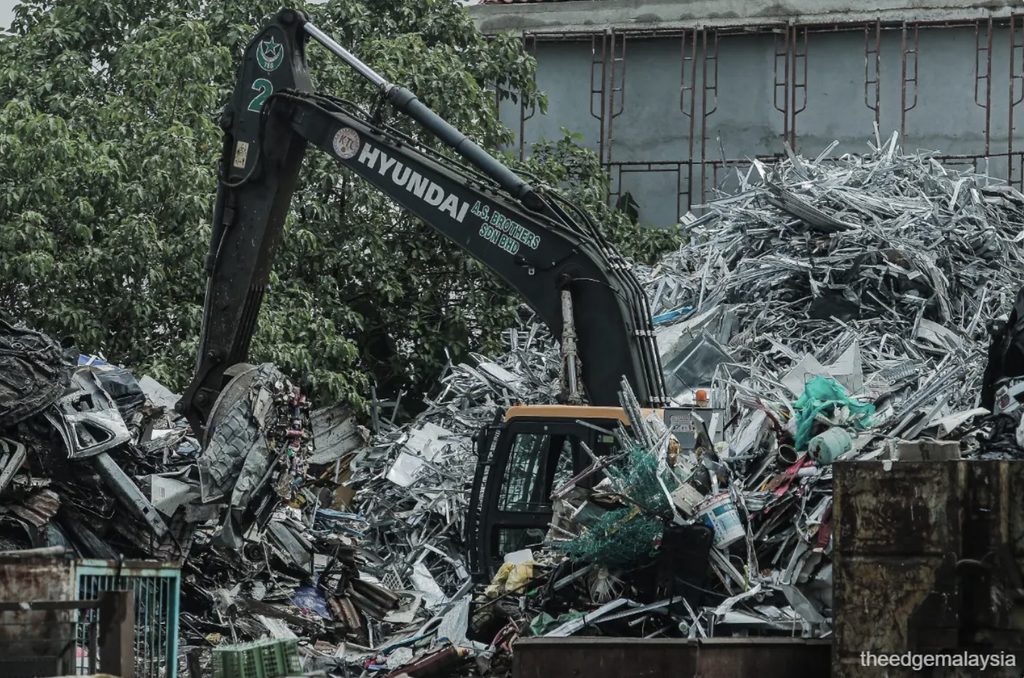
Originally published by The Edge Malaysia on 12 Aug 2026. Photo credit: by Zahid Izzani/The Edge
(Aug 12): Every day, Malaysia generates more than 39 million kilogrammes of solid waste. Yet more than 80% of it ends up in landfills, where mountains of decomposing waste produce methane and contaminated leachate that can pollute the surrounding environment for decades.
The problem is not simply that Malaysians produce too much waste. It is also that much of what could be recovered, recycled or composted is instead thrown away together with general waste.
Wet food waste, for instance, can contaminate cardboard, paper and other recyclable materials when everything is disposed of in the same plastic bag. Valuable materials such as aluminium cans are similarly lost when mixed with general waste. Once recyclable materials become contaminated, recovering them becomes significantly more difficult — and more expensive.
This is not sustainable. Malaysia already has 135 active landfills, and the country is projected to run out of landfill capacity by 2050.
Nor is the answer simply to spend more money on collecting and disposing of waste. For many local authorities, solid waste management and public cleansing already account for 40% to 80% of total expenditure.
The more fundamental question, therefore, is what happens to our waste before it reaches the landfill. The answer begins at source.
Malaysia actually took an important step in this direction more than a decade ago. In September 2015, separation of waste at source was made mandatory under the Solid Waste and Public Cleansing Management Act 2007 (Act 672). Malaysia’s recycling rate has since more than doubled, from 15.7% in 2015 to 37.9% in 2024. Yet separation at source remains inadequately enforced and, crucially, has not been implemented nationwide.
Selangor has long debated introducing such a policy, with plans to formally adopt it this year. If the state is finally going to move forward, the question is no longer simply whether to separate waste at source, but how to make it work.
Make it worthwhile to waste less
The solution begins at home.
Malaysian households can generate as much as 97.3kg of food waste per person annually. One way to reduce this enormous volume is to attach a modest cost to the disposal of general waste through a pay-as-you-throw (PAYT) system.
This does not mean installing expensive smart bins to weigh every household’s waste. Such a system could be overly complicated and costly to implement at scale.
Local governments can instead apply the same PAYT principle through a much simpler mechanism: designated garbage bags sold at a modest fee.
Taipei City provides a useful example. General household waste must generally be disposed of using official Taipei City garbage bags, with the current charge equivalent to approximately five sen per litre. A small 3-litre bag therefore costs roughly 10 sen, or around RM2 for a pack of 20.
Taipei also allows dual-purpose shopping and garbage bags to be sold at convenience stores and supermarkets such as 7-Eleven and FamilyMart. Consumers can first use them to carry their purchases and later reuse them as official garbage bags. It is a simple idea that makes compliance convenient rather than burdensome.
More importantly, households only pay to dispose of general, non-recyclable waste.
Recyclable materials such as plastic bottles, aluminium cans, glass and paper are separated and collected without requiring paid garbage bags. Food waste is similarly separated and deposited into designated food-waste collection bins.
In essence, Taipei follows a straightforward principle: Pay for general waste, recycle for free.
The incentive is immediately understandable. The more waste a household separates for recycling or food-waste collection, the fewer paid garbage bags it needs. Households that produce less general waste therefore pay less.
Rather than investing heavily in technology to weigh individual households’ waste, a designated-bag system offers local governments a relatively simple, low-cost and scalable way to introduce PAYT.
Make the bag part of the solution
The same principle should apply to the bags themselves.
Many Malaysian households still rely on ordinary single-use plastic bags to dispose of food and household waste. These plastics can persist in the environment for generations and contribute to pollution when improperly disposed of.
Italy offers an alternative approach. Bags used for organic waste collection are required to meet regulated compostability standards. Malaysia should consider a similar system so that the very bags used to separate organic waste do not themselves become another long-term waste problem.
The broader lesson is that separation must be made easy, affordable and intuitive.
Malaysia has spent years discussing recycling, but recycling begins long before waste reaches a recycling facility. Building more recycling plants will have limited impact if the materials arriving at their gates have already been contaminated by food waste. Likewise, imposing penalties without giving households convenient ways to separate their waste risks turning another well-intentioned policy into a rule that is widely ignored.
Selangor already has experience using modest environmental charges to change consumer behaviour.
Since 2017, the state has imposed a RM0.20 charge on plastic bags at retail outlets. Collections amounted to approximately RM11.78 million in 2023 and RM8.16 million in 2024. Whatever the remaining shortcomings of the plastic-bag policy, it demonstrates something important: Selangor consumers have already had nearly a decade of experience with a small, behaviour-based environmental charge at the point of consumption.
The concept is therefore not entirely new. A PAYT garbage-bag system simply takes the same principle one step further: if you generate more general waste, you pay a little more; if you reduce, separate and recycle, you pay less.
After more than a decade of discussion, it is time to make separation at source a reality — but it must be easy enough to follow and worthwhile enough to change behaviour.
Malaysia is long overdue for a waste-management system in which throwing food waste, recyclables and general rubbish into a single plastic bag is no longer considered normal.
Separation at source may seem like a small change at the household level. Multiplied across millions of households, however, it could fundamentally change what reaches our landfills, improve the economics of recycling, reduce the burden on local authorities and extend the lifespan of Malaysia’s rapidly diminishing landfill capacity.
One household, one bag and one small act of separation at a time — that could be the giant leap Malaysia’s waste-management system needs.
Instead of boasting about being Malaysia’s most advanced, smartest and largest state economy, the Selangor government now has an opportunity to demonstrate what leadership actually means — by showing the rest of the country how separation at source can work in practice. The ideas are there, the examples are available and the groundwork has been laid. What remains is not a question of capability, but of political will.
Written by Lee Chean Chung & Owen Chong